The short answer. Social media and digital campaigning in India sits inside Election Commission rules: candidates declare their social media accounts at nomination, political ads on social media need pre-certification, campaign spending counts towards the expenditure account, election matter cannot be displayed in the 48 hours before polling, and the Commission has directed campaigns to label AI-generated or synthetic content. Google also asks for advertiser verification and an ECI pre-certificate for election ads in India.
Below is a plain-language summary of those rules, an eight-point digital checklist, and the mistakes campaigns make most often. It was checked on 11 November 2026 and is general information, not legal advice.
The rules in plain words
Election Commission of India instructions are issued for each election, so the exact wording can change. These are the points that come up in almost every campaign, as described in explainers and news reports on the Commission's instructions.
| Rule | What it means for your campaign |
|---|---|
| Social media accounts at nomination | Candidates declare their social media accounts in Form 26. Run only declared accounts as the candidate's official channels. |
| Pre-certification of ads | Political ads on social media need pre-certification by the district or state Media Certification and Monitoring Committee before they run. Plan time for it. |
| Expenditure | Spending on social media ads, content creation and campaign staff counts towards the election expenditure account. Keep invoices. |
| Model Code of Conduct | The Code applies to online content too. Avoid appeals to caste or religion, personal attacks without basis, and false statements. |
| Silence period | Election matter cannot be displayed in the 48 hours before polling (Section 126, Representation of the People Act). Schedule and remove content accordingly. |
| Unlawful or manipulated content | The Commission has said it will act on flagged misleading or unlawful AI-generated or manipulated content on a short timeline, reported as within 3 hours of flagging. |
The Model Code of Conduct is guidance built on the Commission's powers, while parts of the process rest on election rules and the IT Act. Because the legal weight differs, ask your legal team which instruction applies to your election.
Labelling AI-generated content
The Election Commission first advised parties and candidates in January 2025 to label AI-generated content, using notes such as "AI-Generated", "Digitally Enhanced" or "Synthetic Content". A press note dated 19 April 2026, as reported by Business Today, directed parties, candidates and campaign representatives to clearly label election-related posts in this way and to disclose the originating entity.
In practice that means:
- Label any image, video or audio that was generated or materially altered with AI, on the post itself.
- Keep a record of who created each asset, so you can disclose it if asked.
- Do not publish synthetic clips of real people saying or doing things they did not say or do.
- Treat the label as a minimum, because unlabelled synthetic content can also be removed.
Election ads on Google and other platforms
Google's policy for election advertising in India says advertisers must be verified and must provide a pre-certificate issued by the Election Commission of India, or someone it authorises, for each election ad. The policy page was first posted in January 2019 and Google may have updated it since, so read the current version before you plan a campaign.
Other platforms such as Meta and X run their own political and election ad rules, usually covering advertiser authorisation and "paid for by" style disclosures. Check each platform's current policy, and allow extra days for approval, because rejected ads cost time when polling dates are fixed.
An eight-point digital campaign checklist
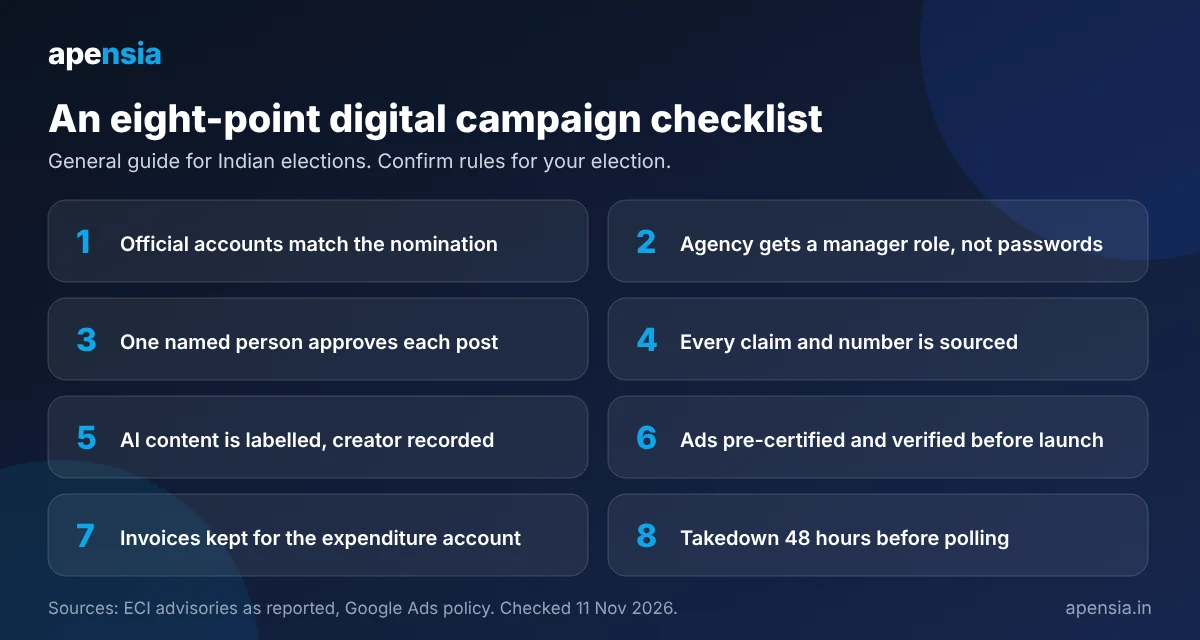
- Accounts. List every official account and confirm it matches the nomination declaration.
- Roles, not passwords. Give the agency a manager role. Never share the candidate's personal login.
- Approval chain. One named person approves each post, and nothing goes out without that sign-off.
- Accuracy check. Every number, quote and claim is sourced before publishing.
- AI labels. Synthetic or enhanced content is labelled, and the creator is recorded.
- Ads. Pre-certification and platform verification are in place before launch, with time to spare.
- Expenditure. Invoices for content, ads and staff are collected and tagged to the campaign.
- Silence period. A scheduled takedown of election matter 48 hours before polling in each constituency.
What a war room should and should not do
A war room is a central desk that monitors media and social conversation, responds to rumours and attacks, checks content before publication, and coordinates the message. A good one verifies before it replies, keeps a log of what was published and who approved it, and escalates serious problems to the candidate and legal team quickly.
It should not run fake accounts, buy engagement, spread unverified claims or harass opponents. Those tactics create legal exposure and damage trust faster than any rumour.
Common mistakes
- Launching ads before pre-certification and then losing days when they are rejected.
- Letting several people post from the candidate's account with no approval step.
- Using AI images or voice clones with no label.
- Forgetting to take down election matter before the silence period begins.
- Not keeping invoices, then struggling with the expenditure account.
- Starting too late, so there is no time to build reach before polling.
People also ask
What are the Election Commission rules for social media campaigning?
Candidates declare their social media accounts at nomination, political ads on social media need pre-certification, spending counts towards election expenditure, the Model Code of Conduct applies online, and election matter cannot be displayed in the 48 hours before polling. Instructions are issued for each election, so check with the election officer.
Do parties and candidates have to label AI-generated content in India?
The Election Commission has directed parties, candidates and campaigners to label AI-generated, digitally enhanced or synthetic election content and to disclose who created it, as reported from its press note of 19 April 2026 and an earlier January 2025 advisory. Check the current note for each election.
Can political parties run election ads on Google in India?
Yes, within Google's election advertising policy for India, which asks for advertiser verification and an Election Commission pre-certificate for each election ad. Check Google's current policy, because the page was first posted in 2019.
What is the silence period before an election?
Under Section 126 of the Representation of the People Act, election matter cannot be displayed in the 48 hours before polling ends. Campaigns schedule takedowns of posts and ads ahead of it.
What is an election war room?
A central team that monitors media and social conversation, responds to rumours, checks content before it is published and keeps the message consistent across channels.
Sources and notes
Checked on 11 November 2026. These are secondary sources and Google's own policy page, not the Election Commission's primary documents, so confirm current instructions with the election officer and your legal team.
- IndiaAI: ECI advisory on labelling AI-generated content (January 2025)
- Business Today: ECI tightens watch on unlawful social media content ahead of 2026 polls (19 April 2026)
- Google Ads Help: pre-certificate and verification requirements for election advertising in India
- Nyaaya: legal explainer on social media advertisements (last updated May 2024)
Related: Political PR agency in India: what it does, cost and how to choose and our political PR services page.