The short answer. A political PR agency plans how a leader, candidate or party communicates with voters, the media and the public: messaging, media relations, digital and social media, monitoring and reputation. To choose one in India, ask each agency for a written scope, named people, work you can verify, how it handles Election Commission rules, and what it refuses to do. Cost has no standard price, because it depends on the election level, constituencies, duration and team size.
This guide explains what the work includes, how to compare agencies, what drives the price, and the red flags to walk away from. It is general information, not legal advice.
What a political PR agency does
Political PR is the planned communication of a leader, candidate, party or cause with the public, the press and supporters. An agency does not decide what you stand for. It helps you say it clearly, get it heard, and respond when something goes wrong. In practice the work falls into six areas.
- Strategy and messaging. One core message, the points that support it, and the audiences it must reach.
- Media relations. Press notes, interviews, briefings and relationships with reporters, so your side is in the coverage.
- Digital and social media. Posts, videos, short clips and ads on the channels your voters use, with a calendar and approvals.
- Monitoring and rapid response. A desk that tracks what is being said and flags rumours early. This is often called a war room.
- Events and press conferences. Planning, scripts and coordination for rallies, launches and media meets.
- Reputation and crisis communication. A plan and approved statements ready before a controversy, and a calm response during one.
Political PR is also used between elections. Leaders and parties keep communication support in place to build trust over time, because reputation built during a campaign is hard to repair afterwards.
How to choose a political PR agency in India
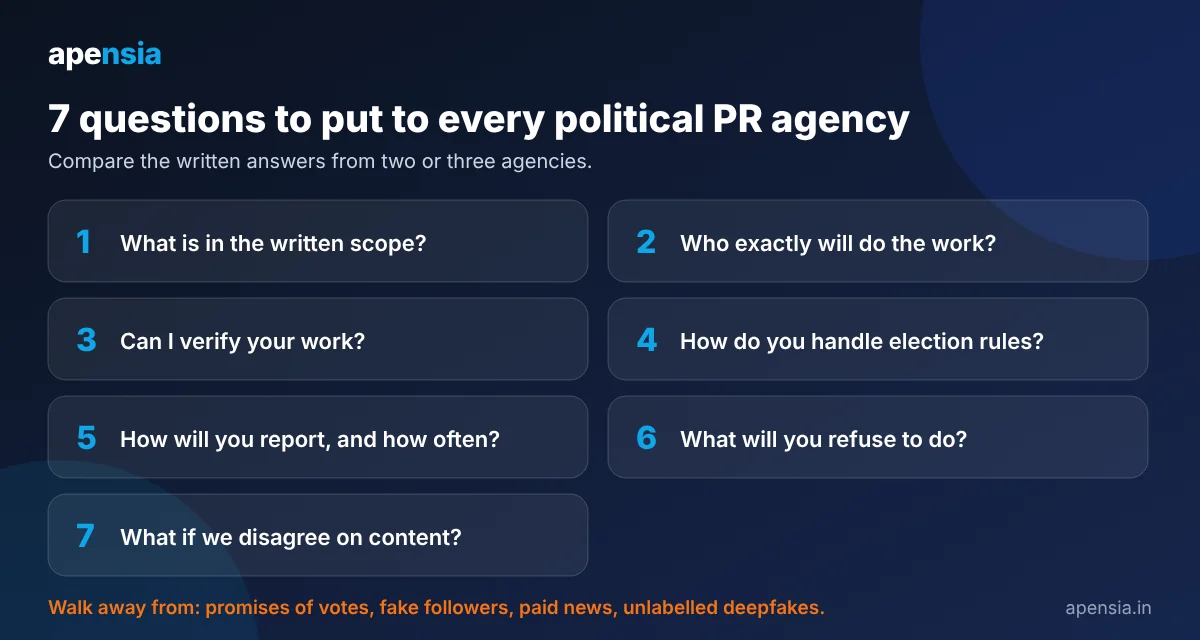
Rankings of "the best political PR company" are usually paid. A more reliable method is to put the same questions to every agency on a shortlist of two or three and compare their written answers.
| Ask | What a good answer looks like |
|---|---|
| What is in the scope? | A written list of services, channels, deliverables, duration and what is excluded |
| Who will do the work? | Named people, and a single contact who answers you |
| Can I verify your work? | Examples you can open, such as press coverage, public pages or campaigns, not only claims |
| How do you handle election rules? | A clear process for approvals, ad pre-certification, expenditure records and labelling of AI-generated content |
| How will you report? | A fixed rhythm, such as weekly summaries, with reach, coverage and sentiment you can check |
| What will you refuse to do? | A direct list: no bots, fake accounts, paid news, deceptive deepfakes or misleading content |
| What happens if we disagree? | Approval steps for content and written terms for changing or ending the work |
Call each agency, not only email them. Clear, specific answers on rules and refusals tell you more about how a campaign will be run than any list of past clients.
What drives the cost of campaign management
There is no standard price list for political PR in India, and any agency quoting one figure without asking about your campaign is guessing. Cost moves with these factors:
- Election level. A panchayat or ward campaign needs a much smaller team than a Lok Sabha seat or a state-wide effort.
- Number of constituencies. More areas mean more local content, coordination and monitoring.
- Duration. A few weeks before polling differs from a year of steady work or an ongoing retainer.
- Team size and skills. Strategists, writers, designers, video editors, social media managers and a monitoring desk.
- Content volume. Posts, videos, press notes, translations and events produced each week.
- Paid media. Ad spend is separate from agency fees and counts towards the election expenditure account.
Ask for a written quote that lists what is included and what is not, and who pays for ads and production. Apensia quotes this way after a scope call. It is a paid service, and we do not do free trial campaigns.
Red flags to walk away from
- A promise of votes, seats or "guaranteed results". Voters decide, and no agency controls that.
- Fake followers, bots, fake accounts or bulk-bought engagement.
- Paid news or "planted" stories presented as independent reporting.
- Deceptive deepfakes, edited clips or AI-generated content with no label.
- A request that you hand over personal social media passwords instead of a proper manager role.
- No written scope, no named people and no process for approving content.
These are not only ethical problems. They can create legal and reputational trouble for the candidate, because the candidate answers for the campaign.
Lok Sabha, Vidhan Sabha, municipal and panchayat campaigns
The method is the same at every level, but the emphasis changes:
- Lok Sabha. Large constituencies and national narratives, so media relations and consistent messaging across many assembly segments matter most.
- Vidhan Sabha. State issues, local leaders and regional language content, with close coordination with the local party unit.
- Municipal and ward. Very local issues, so hyperlocal content and direct voter contact carry the campaign.
- Panchayat. Trust and personal reach, with simple content in the local language and a small, careful digital effort.
Our election campaign rules and digital checklist covers the rules that apply to all of them.
Where Apensia fits
Apensia Media is a political PR and campaign communication agency in Chandigarh, working with leaders, candidates, parties and business brands across India. We cover strategy, media relations, digital and social campaigns, war room monitoring and reputation management, inside Election Commission of India rules. Scope, team, on-ground support and travel are agreed in writing before work starts. We do not use bots, fake accounts, paid news or deceptive deepfakes, and we do not promise votes or results. See the political PR services page.
People also ask
What does a political PR agency do?
It plans how a leader, candidate or party communicates with voters, the media and the public. The work covers messaging, media relations, digital and social media, monitoring and rapid response, events, and reputation and crisis communication. It cannot buy votes or guarantee results.
How do I choose a political PR agency in India?
Ask each agency for a written scope, named people, verifiable work, a process for Election Commission rules, a reporting rhythm and a list of what it refuses to do. Avoid anyone who promises votes or sells fake followers, and compare two or three agencies on the same questions.
How much does political campaign management cost in India?
There is no standard price. It depends on the election level, the number of constituencies, how long the work runs, the team size and the content volume. Ad spend is separate. Ask for a written quote that lists what is and is not included.
Is political PR legal in India?
Yes, communicating a leader's work and message is lawful when it stays within the law and Election Commission of India rules, including the Model Code of Conduct and expenditure accounting. Your legal team should confirm the specifics for each election.
Can a political PR agency guarantee an election win?
No. Voters decide the result. An honest agency can commit to a clear plan, accurate content and regular reporting, but not to an outcome.
Sources and notes
This guide is general information for readers choosing an agency, written by Apensia Media on 11 November 2026, and it is not legal advice. Election rules are issued for each election, so confirm them with the election officer and your legal team. Related: Election campaign management in India: rules and digital checklist.