Social media and digital marketing work when each channel has a job (create demand, capture demand or build trust), every link carries tracking, and every enquiry is followed to a sale. Pick one or two channels where your customers already are, publish consistently from a simple content system, treat reviews as part of marketing, and judge results by cost per enquiry and cost per customer. Followers and likes are not the goal.
Give every channel a job
"We need to be on social media" is not a strategy. Channels do different jobs, and confusing them wastes money.
- Capture demand (Google Search, Google Business Profile, marketplaces): people already looking for what you sell. Highest intent, so it usually converts best.
- Create demand (Instagram, Facebook, YouTube, LinkedIn): people who did not know they needed you yet. Slower, and needs good creative.
- Build trust (reviews, case studies, press, founder content): the proof that makes the other two work. A buyer who finds you through a search will check your Instagram and your reviews before calling.
Most small businesses do best with one capture channel and one create or trust channel, done well, rather than five channels done thinly.
Choosing channels by audience, not fashion
| Business type | Start with | Why |
|---|---|---|
| Local services, clinics, restaurants | Google Business Profile, Instagram, reviews | Local intent and visual proof |
| B2B, software, consultancies | LinkedIn, SEO, email | Decision makers research and follow professionals |
| Ecommerce and fashion | Instagram, Meta ads, Google Shopping | Visual discovery plus intent capture |
| Education and training | YouTube, Instagram, WhatsApp, SEO | Demonstrate expertise, handle questions personally |
| Real estate and high-ticket | Google Ads, Meta lead ads, video | Qualified leads and a follow-up process |
Ask your own customers where they look before they buy. Their answer beats any generic advice, including ours.
A content system that does not burn out
Consistency beats bursts. A sustainable system has four parts:
- Pillars: three to five topics your customers care about and you can speak about with authority.
- Formats: a few repeatable types, such as a how-to, a client story, a myth-bust, a behind-the-scenes, a short video.
- A calendar: planned a month ahead, with approvals so nothing is rushed.
- Repurposing: one idea becomes a blog post, a short video, three posts and an email. That is where the efficiency comes from.
Quality signals matter more than volume: original photos and video from your actual work, named people, real numbers, and honest answers. Avoid buying followers, comments or likes. Fake engagement is against platform rules and, for anything tied to your website, against Google's spam policies. It does not produce customers.
Meta ads (Facebook and Instagram): what to know
Meta ads reach people by interest, behaviour and location, rather than by what they typed. They suit products with visual appeal, local offers, events and lead generation. The mechanics that determine results:
- Objective first: choose leads, sales or traffic to match your goal, because the system optimises for what you pick.
- Creative is the targeting. Strong visuals and a clear hook matter more than fine-tuned audiences. Test several variations.
- Tracking: install the Meta Pixel, and where possible the Conversions API, so the platform sees real conversions. Without it, optimisation is blind.
- Lead forms vs landing pages: in-app lead forms are quick and produce more leads, often of lower intent. A landing page filters better. Test both and compare by customers, not leads.
- Follow-up speed: calling a new lead within minutes dramatically improves contact rates. A slow response wastes the ad spend.
- Frequency and fatigue: refresh creative when performance drops.
Reviews and online reputation management
Before most people buy, they check what others say. Reputation is not a crisis service; it is steady habit.
Earn reviews
Ask every satisfied customer, at the moment they are happiest, with a direct link to your Google Business Profile review form. Do not offer payment or discounts in exchange for reviews, and do not review your own business: it violates policies and can lead to removal.
Respond to all of them
Thank positive reviewers by name. Reply to negative reviews calmly and factually, offer to resolve it offline, and never argue. Prospective customers read the replies as much as the complaint.
Handle false or harmful content properly
Reviews that break the platform's content policy (spam, fake, off-topic or abusive) can be reported for removal. Genuine criticism cannot, and trying to suppress it usually backfires. The better route is to resolve the issue, ask happy customers for reviews, and publish your own useful content so that your owned pages occupy more of the first results for your brand name.
Monitor
Set up alerts for your brand name, so you hear about problems early. Our digital PR page covers building positive coverage and handling brand issues.
Lead generation: tracking from first click to paying customer
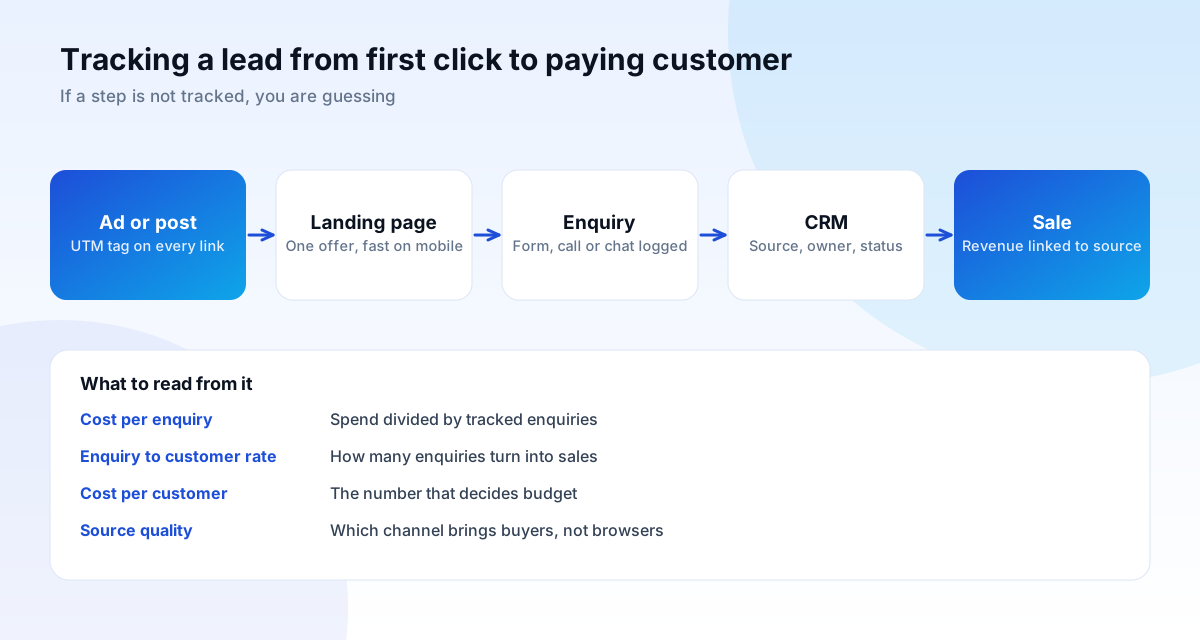
A lead is not a result until it is a customer. To know which marketing works, you need a chain of records:
- Tag every link with UTM parameters (source, medium, campaign), so analytics knows where a visit came from.
- Capture the source with the enquiry, in a hidden form field or in your CRM, because analytics sessions and enquiries are otherwise unconnected.
- Log every enquiry in one place: forms, calls and chat go into a CRM or even a shared sheet, with an owner and a status.
- Record the outcome: won, lost and the value. Without this, you can only count leads.
- Feed the result back into Google Ads or Meta so that bidding learns what a good lead is.
The numbers that matter
- Cost per enquiry: spend divided by tracked enquiries.
- Enquiry-to-customer rate: how many enquiries become sales.
- Cost per customer: the number that decides how much you can spend.
- Source quality: which channel brings buyers, not browsers.
- Response time: how long a new lead waits for a first reply.
Followers, reach and likes are useful for diagnosing creative, but they are not business results. We report the numbers above, every month, in plain English.
WhatsApp, email and follow-up
In India, WhatsApp is often where a lead becomes a conversation. The WhatsApp Business app suits small teams, and the Business API, which requires approved message templates for business-initiated messages, suits larger volumes and automation. Always get consent before messaging, make opting out easy, and keep messages useful.
Email remains the cheapest way to nurture people who are not ready yet: a short welcome sequence, a monthly useful note and offers tied to real events. A simple, steady follow-up often matters more than clever targeting.
What it costs
Our digital marketing management starts from ₹20,000 a month (about $240), with ad spend separate and paid directly to the platforms from your account. Content production, video and influencer fees are scoped separately. The monthly fee covers strategy, setup, tracking, optimisation and reporting. See the pricing on our homepage.
A realistic 90-day plan
Days 1 to 30: foundations
- Choose goals and the one or two channels. Set up tracking: UTMs, Pixel, conversion events, a CRM or shared lead sheet.
- Complete your Google Business Profile and social profiles. Pull together the best photos, testimonials and facts.
- Define three to five content pillars, and write the first month's calendar.
Days 31 to 60: publish and test
- Publish consistently and record what each post achieves. Start a small paid test with two or three creative variations.
- Start asking every customer for a review, with a direct link.
- Review lead quality weekly with whoever answers the calls.
Days 61 to 90: learn and scale what works
- Stop the weakest formats and creative. Put more budget behind what produced customers, not only enquiries.
- Add an email or WhatsApp follow-up sequence for people not ready yet.
- Produce a clear report: spend, enquiries, customers, cost per customer and what comes next.
Mistakes that waste a marketing budget
- Posting without a goal, then judging by likes.
- No tracking, so no one knows which channel works.
- Slow follow-up. Leads go cold within hours.
- Buying followers or reviews, which creates no customers and risks penalties.
- Stopping too soon. Most channels need a few months of consistent work and testing.
- Letting an agency own your ad accounts and pages.
Common questions
Do I need to be on every platform?
No. Pick one or two where your customers are and do them properly. Spreading thin helps nobody.
How long before social media brings customers?
Paid campaigns can produce enquiries within weeks. Organic social builds over months. Treat it as a trust and demand channel, and pair it with search for intent.
Should I buy followers or reviews?
No. It breaks platform rules, can get accounts penalised and does not create customers.
What if a competitor posts fake negative reviews?
Report them to the platform with evidence, keep screenshots, reply professionally and keep collecting genuine reviews. Escalate legally only on advice.
Can you manage my accounts?
Yes. Accounts stay in your name with us added as managers, so you always own the audience and data.