SEO has four working parts: technical (can Google crawl, index and render your pages), on-page (does each page answer a real question clearly), off-page (do other trustworthy sites mention and link to you) and local (do you appear for nearby searches and on Google Maps). Good SEO is measured in enquiries, not rankings, and no honest provider promises a position. Google says its AI features rely on the same foundation, so this work also helps AI search.
SEO in one page
Search engine optimisation is the work of making your site easy for search engines to understand and worth showing to people. Search engines do three things: they crawl (find pages), index (store and understand them) and rank (choose which to show for a query). SEO services are the activities that improve each step.
It is useful to separate four disciplines, because they need different skills and fail in different ways. A site can have flawless technical SEO and still not rank because the content says nothing new, or have excellent content that Google cannot index.
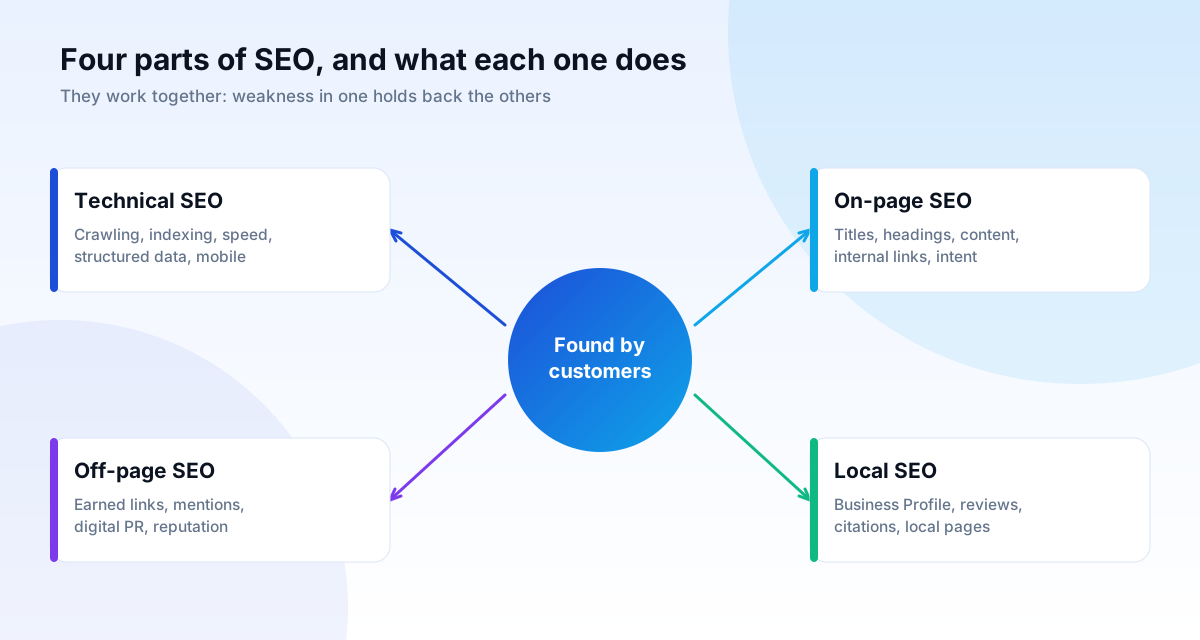
Technical SEO: can Google crawl, index and render your site?
Technical SEO is the plumbing. If it is wrong, nothing else matters, because the pages never make it into the index or load too badly to keep visitors. A technical audit typically checks:
Crawling and indexing
- robots.txt is not blocking important sections, and not accidentally blocking CSS or JavaScript Google needs to render the page.
- noindex tags and canonical tags are used deliberately. A single stray noindex can remove a page from Google.
- XML sitemap lists the canonical, indexable URLs and is submitted in Google Search Console.
- Index coverage in Search Console: which pages are indexed, which are excluded and why.
- Redirects and status codes: no chains, loops or broken pages; permanent moves use 301 redirects.
Site structure and internal links
Important pages should be reachable within a few clicks and linked from related pages with descriptive anchor text. Orphan pages, with no internal links, are hard for Google to discover and signal that you do not value them.
Rendering and speed
If content is injected by JavaScript, Google must render the page to see it, which can delay or break indexing. Core Web Vitals (LCP, INP and CLS) are measured on real visits and feed into Google's page experience signals. Compress images, reduce JavaScript, use caching and fix layout shifts. Our website guide lists the thresholds and tactics.
Structured data
Schema markup describes entities on a page: your organisation, a local business, an article, a product, a breadcrumb trail. It helps Google understand the page and can make it eligible for rich results. It must match visible content and is not a ranking shortcut.
Mobile, security and international
Google indexes the mobile version of a page, so mobile content must be complete. HTTPS is expected. If you serve several countries or languages, hreflang tags tell Google which version suits which audience.
On-page SEO: does each page answer a real question?
On-page SEO is the craft of making one page the best answer to one question. It starts with intent: what is the searcher actually trying to do?
| Intent | Example query | The page should be |
|---|---|---|
| Learn | how long does SEO take | A clear, sourced explanation |
| Compare | WordPress vs Shopify | A fair comparison with trade-offs |
| Local | web designer near me | A location page with address, map and proof |
| Buy / hire | SEO packages price India | A service page with pricing and a next step |
The elements we work on page by page:
- Title and meta description: a descriptive title that matches the query and earns the click. Google may rewrite them, but a good starting point helps.
- One H1 and a logical heading outline, using the language customers use.
- Content that adds something: original experience, examples, data, comparisons and answers, not a paraphrase of the first page of results.
- Internal links to related pages and next steps.
- Images with meaningful file names and alt text that describes what is shown.
- Entities and context: naming people, places, products and standards accurately, so the page is clearly about what it claims.
Keyword research tells you the words customers use and how competitive each topic is. It is an input, not a recipe. Pages written for readers and edited for search outperform pages written for a keyword density target.
Off-page SEO: links, mentions and reputation
Links from other sites remain one of the ways Google judges whether a site is trusted. But the quality and the way links are earned matter far more than the count.
What works
- Original research, tools and guides that people cite because they are useful.
- Digital PR: newsworthy angles, expert comment and genuine press coverage.
- Relevant partnerships: suppliers, industry bodies, event organisers and clients who mention you on their own pages.
- Directory and profile listings that real customers use, such as Clutch, GoodFirms or industry directories.
- Brand mentions and reviews across the web, which build the reputation search engines try to measure.
What to avoid
Google's spam policies call out link spam: buying or selling links that pass ranking signals, large-scale exchange schemes, automated link creation and low-quality guest posts. Paid or sponsored links should carry the rel="sponsored" attribute and user-generated links rel="ugc". A sudden wave of low-quality links can do harm, and a "100 backlinks for a small fee" offer is a warning sign. Our link building strategies guide goes further.
Local SEO: showing up nearby and on the map
If customers search "near me" or include a city, Google shows a map and a short list of local businesses above or among the usual results. Local SEO is how you get into that list.
- Google Business Profile: claimed, verified and complete, with the correct name, category, address, hours, services, photos and a link to the right page.
- Reviews: ask real customers, reply to all of them politely, and never buy or incentivise reviews, which breaks Google's policies.
- Consistent name, address and phone (NAP) across your website and listings.
- Location pages with unique, useful content about the area you serve, not the same page with the city name swapped.
- Local links and citations from chambers, directories and local organisations.
- LocalBusiness schema and an embedded map on the contact page.
Proximity, relevance and prominence decide local rankings. You cannot move your office, but you can improve the other two. Our local SEO page describes how we run it for Chandigarh, Mohali and Panchkula businesses.
Content, E-E-A-T and AI search
Google's quality systems look for helpful, reliable content created for people. Its published guidance for AI features, AI Overviews and AI Mode, is direct: optimising for them is still SEO, with no special markup, file or rewrite required. What it rewards is what has always worked: original, non-commodity content, accurate information, clear structure and a good page experience.
In practice, we write pages that show experience (who did this, with what result), cite primary sources, answer the question early, and are easy to quote. Scaled content abuse, producing large numbers of pages mainly to catch search queries, violates Google's spam policies, so we write fewer, better pages. See our AI search guide for the details.
Ecommerce, WordPress and platform-specific SEO
Platforms add their own quirks. WordPress needs control of plugin bloat, duplicate archives and slow themes. Shopify has fixed URL patterns that need careful canonical handling. WooCommerce stores need category-led structure and product schema. A competent SEO service knows the platform it is working on and fixes its typical issues, which is why we cover them in the ecommerce guide and audit CMS-specific problems separately.
What good monthly SEO work looks like
If you hire a provider for ongoing SEO, you should see a rhythm like this:
- Month 1, audit and fixes: technical issues, tracking, Business Profile and a prioritised plan.
- Months 2 and 3, build: improved key pages, new content aimed at real questions, internal links, citation clean-up.
- Months 3 to 6, grow: authority building, further content, conversion improvements as data arrives.
- Every month: a plain-English report showing enquiries, the pages and queries that changed, what was done and what comes next.
Our timeline guide explains why results take months and what to judge in the meantime.
How to measure SEO
Rankings alone mislead: they change by location, device and personalisation. Measure outcomes:
- Enquiries and their source, through forms, calls and chat tracked as conversions.
- Google Search Console: impressions, clicks, click-through rate and average position for pages and queries.
- Google Business Profile insights: calls, direction requests and website clicks.
- Cost per enquiry, when SEO is compared with paid channels.
- Index coverage and Core Web Vitals, as health checks.
Red flags in SEO proposals
- A guaranteed ranking, or a guaranteed number of days. Nobody controls Google.
- No access to your own Search Console, Analytics or Business Profile.
- Vague deliverables: "SEO optimisation" with no list of what is done.
- Large bundles of cheap links, directory submissions or "AI articles".
- Lock-in contracts with no exit and no reporting.
- No questions about your business, customers or margins.
We publish our starting prices (local SEO from ₹15,000 to ₹30,000 a month, one-off audit from ₹15,000), report in enquiries, and do not lock you in. See the pricing on our homepage.
A practical technical SEO audit checklist
If you want to check a site yourself before hiring anyone, work through this in order. Each step needs only free tools: Google Search Console, a browser, and a speed test.
- Is the site indexed? Search
site:yourdomain.comin Google and compare the number of results with the number of pages you expect. In Search Console, open the Pages report and read why pages are excluded. - Is the homepage indexable? Use the URL Inspection tool on the homepage and a key service page. Confirm Google can fetch and render them.
- Is robots.txt sane? Visit
/robots.txt. A line such asDisallow: /blocks the whole site. - Do key pages have unique titles and one H1? Duplicate titles across many pages are a sign of template problems.
- Do old URLs redirect? After any redesign, old addresses should 301 to the new equivalent.
- Is mobile content complete? Compare what a phone shows with a desktop; hidden or removed content may not be indexed.
- How are Core Web Vitals? The Search Console report shows field data for groups of pages.
- Are there manual actions or security issues? Both are reported in Search Console.
- Do pages link to each other? Pick a service page and check how many internal links point to it.
- Is the structured data valid and honest? Test the key templates and confirm the data matches the visible page.
Fixing the first three often gives the biggest and fastest gain, because a page that is not indexed cannot rank at all.
A worked example: rewriting one service page
Take a hypothetical "Web design services" page that is a 150-word paragraph with a stock photo, a generic title ("Services") and no internal links. Searchers want to know what is included, what it costs, how long it takes and whether you are trustworthy. A rewrite would:
- Retitle it "Web Design Services in Chandigarh | Starter Sites From ₹25,000", matching how people search and stating a price.
- Open with a two-sentence answer: who it is for, what is delivered, and the next step.
- Add sections for process, what is included, pricing, timeline, and examples with links to live client sites.
- Answer the five questions customers ask before buying, as a visible FAQ.
- Link to the relevant guides and to the contact page, and receive links from related pages.
- Add Service and Breadcrumb schema that matches the content.
The result is not a "keyword-optimised" page. It is simply a page that answers the buyer's questions better than the next result, which is what Google tries to surface.
SEO glossary
- Crawl
- When Google's bot visits a page and follows its links.
- Index
- Google's stored copy of a page. Only indexed pages can appear in results.
- Canonical URL
- The preferred version of a page when several addresses show similar content.
- Anchor text
- The clickable words of a link. Descriptive anchors help users and search engines.
- Backlink
- A link to your site from another website.
- Schema / structured data
- Code that labels what a page is about, such as a business, product or article.
- Search Console
- Google's free tool showing how your site performs in search and what is wrong.
- Core Web Vitals
- Three real-user metrics of loading, responsiveness and visual stability.
- NAP
- Name, address and phone number, kept consistent for local SEO.
- SERP
- The search engine results page.
Common questions
Is SEO worth it for a small local business?
Often, yes, especially local SEO, because customers searching nearby have high intent. The first step is a free review of what you already have, so you can see whether SEO is the right spend or whether the website needs fixing first.
Can I do SEO myself?
Much of it, yes: claim your Business Profile, ask for reviews, write helpful pages. A professional helps most with technical problems, competitive markets and measurement.
How many keywords should I target?
Think in topics and pages, not a keyword count. Each page should serve one main intent and naturally covers related phrases.
Does SEO work for AI search and voice?
Yes. Google states that AI features use the same ranking and quality foundations as ordinary search, so clear, original, well-structured pages serve all of them.
What is the difference between SEO and SEM?
SEO earns unpaid results by improving your site. SEM usually refers to paid search advertising such as Google Ads. They work well together: paid gives quick data, SEO builds lasting visibility.
Sources
- Google Search Central: SEO Starter Guide
- Google Search Central: Spam policies for Google web search
- Google Search Central: Introduction to robots.txt
- Google Search Central: Introduction to structured data
- Google Search Central: JavaScript SEO basics
- Google Search Central: Optimizing your website for generative AI features on Google Search
- Google Business Profile Help