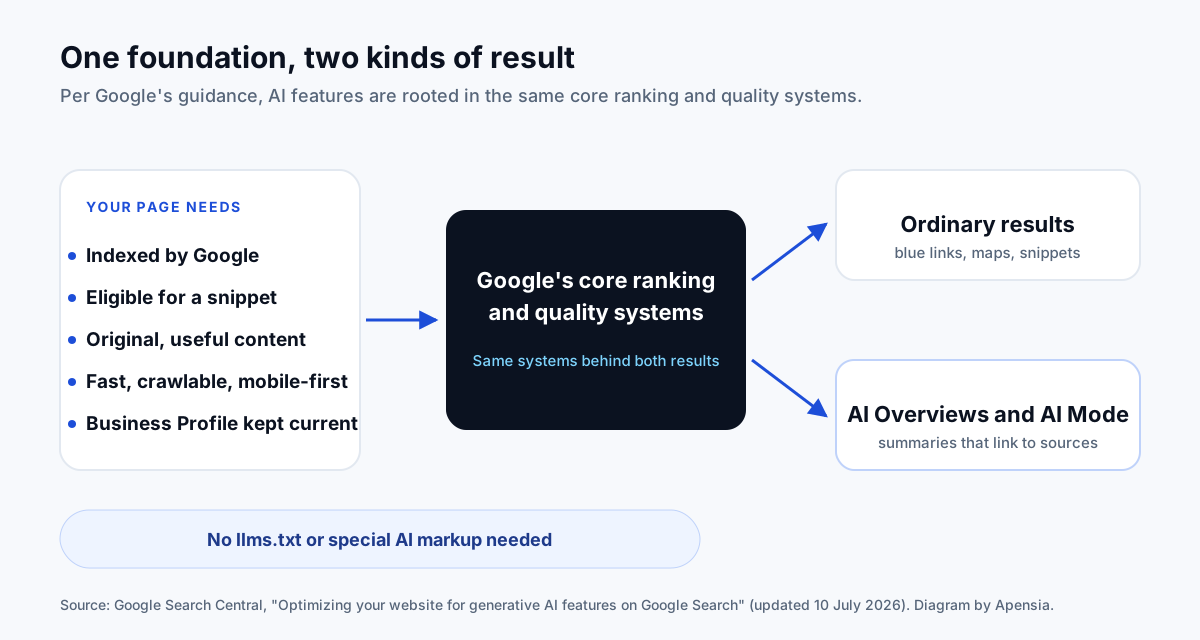
Google says that optimizing for its generative AI features is still SEO. AI Overviews and AI Mode are rooted in the same core ranking and quality systems as ordinary results, so the work that matters is the usual work: a page Google can index and show a snippet from, with original content that adds something a summary of the web cannot. You do not need llms.txt, special markup or content chopped into pieces.
What are AI Overviews and AI Mode?
They are the parts of Google Search that write a summary answer and link to the pages it drew on. Some searches now show that summary above the usual list of links, and AI Mode lets a person keep asking follow-up questions in the same conversation.
For a business, the practical question is not how the summary works inside. It is whether your page is one of the sources Google can find, trust and quote.
Is AEO or GEO different from SEO?
Not according to Google. Its own guide to optimizing for generative AI features says that the best practices for SEO continue to be relevant, because these features are built on its core Search ranking and quality systems. The guide was updated on 10 July 2026.
Plenty of agencies sell “AEO” and “GEO” as separate services. Some of what they offer is simply good SEO under a new name. Some of it is advice Google specifically says you can skip. Before you pay for either, ask which part is not already ordinary SEO.
What does Google say you do not need to do?
Google’s guide has a section on myths. As it is reported and quoted, these are not required to appear in AI features:
- An llms.txt file or other special markup. Google Search does not use them. Creating one is fine for other services but will neither help nor harm your Google visibility.
- Chopping content into tiny pieces. There is no requirement to break a page into small chunks and no ideal page length.
- Rewriting everything in a special way for AI. The systems understand synonyms and general meaning.
- Special schema for AI. Structured data is not required, and there is no special schema.org markup for generative AI search. It is still useful for rich results.
- Mass-producing pages for related questions. Google says creating many pages to target related queries in order to manipulate rankings violates its scaled content abuse spam policy.
That last point matters if you are tempted to publish dozens of thin articles. It is the opposite of what Google is asking for.
What does help a page get used?
Google points to the same fundamentals, in this order of importance for most small businesses:
- Original content. Google asks for content that adds your own knowledge and experience, not a rewrite of what is already online or what an AI tool could produce unaided.
- A clear technical foundation. The page must be indexed and eligible to show a snippet. Crawlable links, a fast mobile page, and no duplicate copies of the same content all matter.
- Accurate local and product details. For local businesses, that means your Google Business Profile. For shops, it means product data in Merchant Center.
- Good images and video that support the page, with descriptive alt text.
Google’s guide also says plenty of content does well in Search, including its AI features, without any overt SEO at all. Being useful comes first.
What about voice search and autocomplete?
Voice assistants and AI answers tend to favour a short, direct answer to a plainly worded question. That is our practice rather than a Google rule, and it costs nothing: we put the answer first, in two or three sentences, and the detail after it. You can see it at the top of this page.
Autocomplete suggestions are useful for one thing, which is hearing how real people phrase a problem. We use them to word headings and questions naturally. We do not stuff them into pages as keyword lists.
The checklist we use on every site
- Every important page is indexed, and Search Console shows no exclusion you did not choose.
- Each page opens with a direct answer to the question it exists for, followed by the detail.
- Headings are written as the questions customers really ask.
- Pages say something specific to your business: your prices, your process, your results.
- Structured data describes only what is visibly on the page. We use it for rich-result eligibility, not as an AI trick.
- Your Google Business Profile, opening hours, address and services match your website.
- Images are original or genuinely useful, compressed, and have plain alt text that describes them.
- We check Search Console each month, including how the site appears in Google’s AI features, and report enquiries rather than rankings.
If you want us to run that checklist against your site, the AI SEO insights article explains what is real and what is oversold, and our technical SEO and local SEO work covers the foundation underneath it.